Pennington County’s appeal page separates city and county properties, while current state law also distinguishes local boards and nonresident owners. Start with your assessment notice and Equalization to identify the receiving clerk. Ask Equalization for the home record and confirm current property-search availability.
Pennington County property taxes at a glance
- Typical home value
- $302,200Middle value, owner-occupied homes
- Typical yearly tax
- $3,265Middle payment, owner-occupied homes
- Home assessment basis
- Market valueExpected open-market sale price
- Home valuation date
- November 1Before the assessment year
Your appeal deadline
For an ordinary local appeal, mail or file written notice with the municipal or township board clerk by Thursday before the third Monday in March. A timely postmark counts for this route. Appeals of a local decision go to the County Auditor by the first Tuesday in April.
A local board ordinarily hears the case first where one exists. An owner who lives outside that taxing district may use direct county review; unorganized territory and consolidated boards also have county-level routes. Check your notice and ask the Auditor which applies. For direct county review, obtain proof that the County received your appeal by the deadline.
Use the recurring Local Board or County/consolidated deadline above for the board on your assessment notice. Confirm the correct filing recipient before submitting.
How to file your appeal
Pennington’s Equalization page offers the first step: discuss your assessment and sales with an appraiser at 605-394-2175, 900 Concourse Drive, Rapid City, SD 57703, weekdays 7 a.m.–4 p.m. For written county-stage notice, state law names the County Auditor. That office lists mail at PO Box 6160, Rapid City, SD 57709, and office delivery at 900 Concourse Drive, Suite 130, Rapid City, SD 57703, weekdays 7 a.m.–4 p.m.; phone 605-394-2153.
Identify the receiving clerk
Read the assessment notice for your municipal or township board and receiving clerk. Local review ordinarily comes first; the county and consolidated routes have their own rules. Call the County Auditor if you need to identify the correct board before sending your written notice.
Prepare the written notice
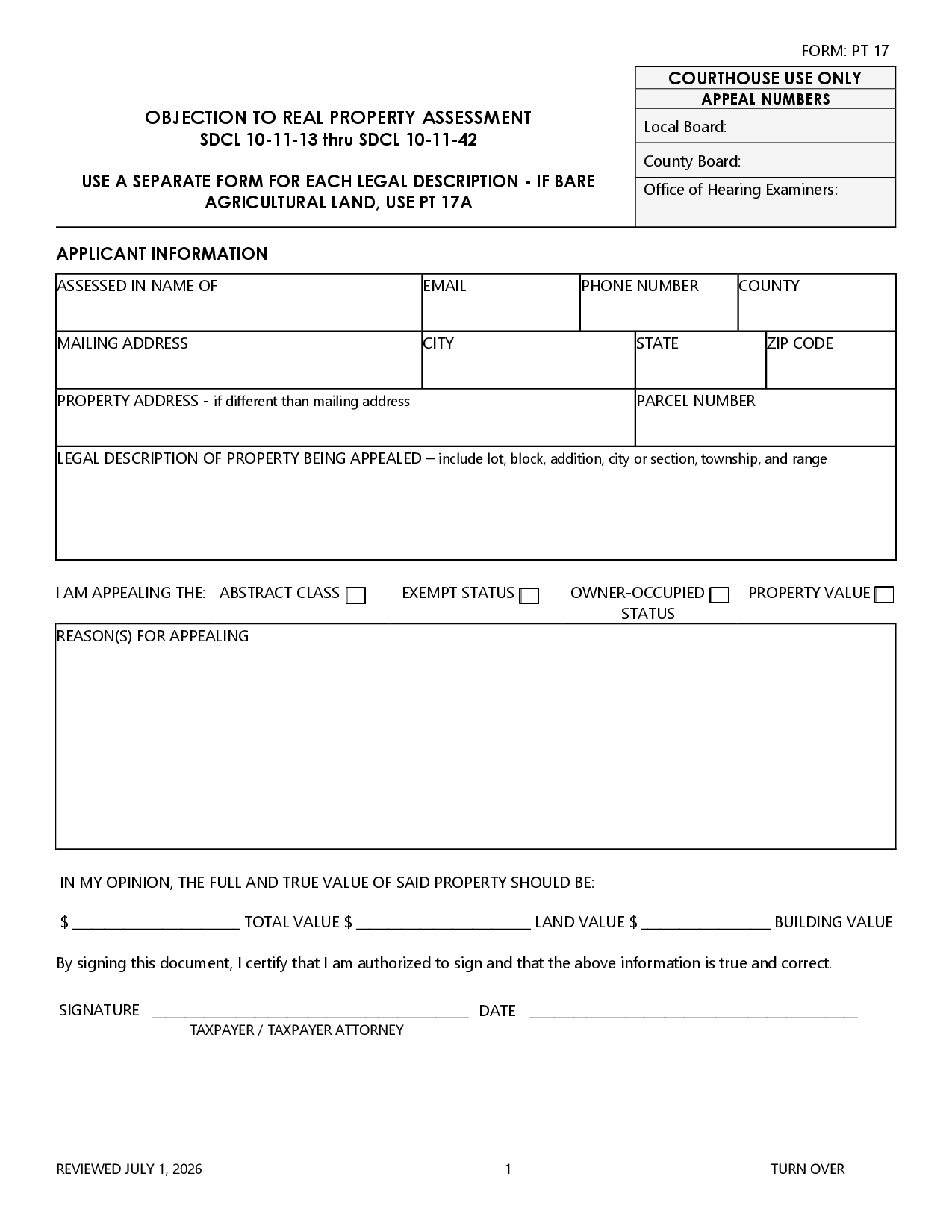
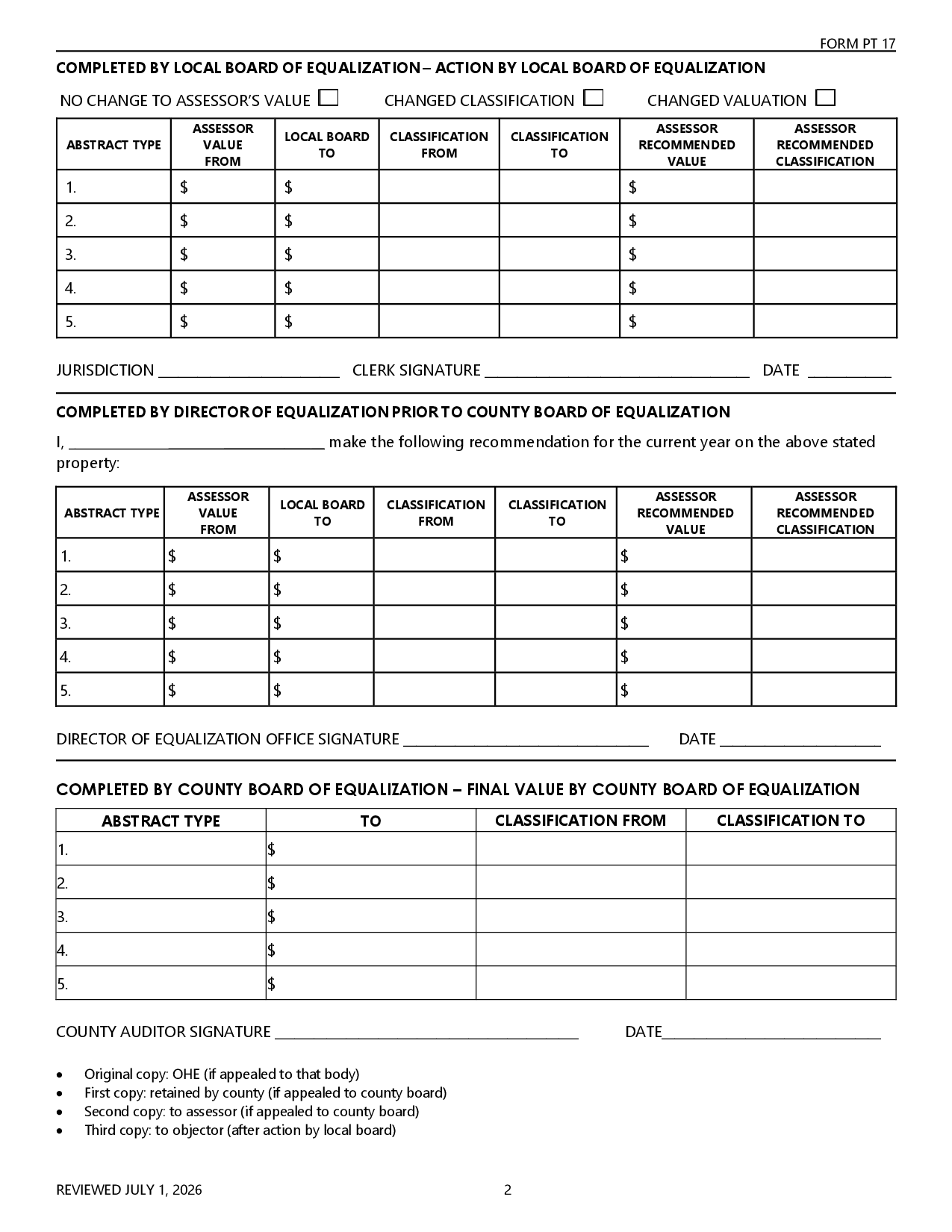
The Department of Revenue allows an initial written letter with your name, the property’s legal description and a brief reason for appeal. A signed PT17 is another option. PT17 adds your contact and parcel details, appeal category, proposed total/land/building values and taxpayer or attorney signature/date; use a separate form for each legal description. Leave the official-action sections blank.
Deliver to the correct clerk or Auditor
For the local stage, mail or file the written notice with the municipal or township board clerk identified on your assessment notice. For the county or consolidated stage, use the County Auditor and the applicable April rule. Keep a complete copy and receipt evidence. The PT17 website can only print or save; it does not submit the appeal. This guide uses the written mail or office-delivery route and does not identify a verified appeal email inbox.
The county’s appeal instructions also name Equalization in its city/county coordination instructions. That does not replace the statutory receiving local clerk or County Auditor, or the local-first rule where it applies. Identify your board from the assessment notice and coordinate with Equalization before delivery; keep evidence that the written notice reached the proper recipient.
Send written notice to the correct board. Ask the clerk about any additional representation authorization and hearing requirements that apply to your case.
These steps address an ordinary home-value objection. The Department of Revenue’s instructions send owner-occupied or taxable/exempt-status appeals directly to the County Board. Identify your appeal category before choosing the receiving board.
Has your home been valued too high?
At the October 19, 2026 factual review, Equalization’s main page listed Property Search and Public Access as unavailable during the county’s cybersecurity recovery. Check the current service alert. Contact the office for your notice, home record and value explanation. The county also links RapidMap through Rapid City’s GIS department; the city describes the map data as reference-only and does not guarantee its accuracy or timeliness. Neither map access nor payment-system recovery establishes a working property-card lookup.
Ordinary home assessments use expected market value, not the tax bill amount. Match your records to November 1 before the assessment year and explain the total property value. The countywide survey medians above cannot establish the value or tax savings of your particular home.
The 3% limit concerns the countywide total assessed value of owner-occupied single-family homes for taxes payable in 2027–2031. An individual home can increase by more than 3%. New improvements, reclassification and required assessment-ratio adjustments affect the county total. Base a value objection on your home’s record and market evidence.
How to show what your home was worth
Explain why the actual home record and comparable properties support your proposed total value. Gather completed sale records, their dates and property characteristics. Point out relevant differences instead of only stating that the assessment is too high. Ask the board clerk how and when to submit documents and other evidence.
Prepare an explanation using your own records
Copy the parcel number, legal description and assessment year from your notice. Identify the recorded feature or total value you dispute. Attach dated photos, plans or other records showing the home’s condition on November 1 before that assessment year.
For each actual comparison, list the property address, sale date and price or assessment, and the source record. Compare size, location, age, features and condition with your home. Explain how the relevant differences support the total value you request.
Adapt this outline: “For [property and assessment year], I request a total value of [supported amount]. The record shows [disputed feature or value]. [Named evidence] supports [correction or comparison] because [specific explanation].” If you use PT17, put the total and any separate land and building amounts in the matching fields. Keep the notice, evidence and proof of filing together.
What happens after filing
The receiving clerk or board tells you when your appeal will be heard. Bring or submit the explanation and evidence requested for your case. Keep the written decision and the notice dates if you want another review.
A local board gives written notice seven days after adjournment; a county board’s written notice must be postmarked by the Friday after its adjournment. A further appeal to the Office of Hearing Examiners is due the third Friday in May. For direct circuit-court review, the 30-day period starts with the later of the published county decision notice or the served written notice. You cannot pursue both routes simultaneously. Check the decision and current filing instructions before choosing a route.
When notices and tax bills arrive
Pennington’s notice identifies the tax district, assessed property and appeal instructions. Its assessed value refers to the previous November 1, with taxes payable the following year. Read that district information before choosing a receiving board.
The assessment notice is sent by March 1 and starts the spring review process. It is separate from the tax bill. Taxes based on an assessment are paid the following year; waiting for that bill can miss the assessment appeal window.
Keep payment dates separate from filing dates. Ordinary tax installments are paid by April 30 and October 31 to avoid delinquency; a bill totaling $50 or less is paid in full by April 30. If month-end falls on a weekend, office receipt uses the last working day, while mailing must be postmarked before delinquency. Check your Treasurer’s current instructions and actual bill.
Other property tax relief
A value appeal and a relief application are different tasks. Ask Equalization about owner-occupied classification and the Treasurer about relief for qualifying older or disabled homeowners. Check the current program, application deadline and eligibility before applying.
Who to contact in Pennington County
Pennington County Equalization
900 Concourse Drive
Rapid City, SD 57703
Pennington County Auditor
PO Box 6160
Rapid City, SD 57709
Pennington County property tax appeal questions
Can I go straight to the County Auditor?
Only when the applicable county or consolidated route permits it. A local board normally comes first where one exists; nonresident owners of that local taxing district and unorganized territory have exceptions. Identify the board on your notice and confirm it with the Auditor.
Does filling in the online PT17 file the appeal?
No. The PT17 website says the form is for printing or saving and cannot submit electronically. Send the written notice to the proper clerk or Auditor and confirm receipt.
Should I challenge only the house or only the land?
Explain the total property value. The ordinary appeal covers the total value even when your reason concerns a particular building or land feature. Bare agricultural land uses PT17A rather than the home form.
Is the median yearly tax an estimate of my bill?
No. It is the middle tax payment reported for owner-occupied homes during 2020–2024. It is not your assessment, current bill or expected appeal savings.
How do I appeal a property assessment in Rapid City?
Check the county and assessment office on your value notice first. For a home in the Pennington County part of Rapid City, use the filing steps and appeal deadline in this area guide when they match your notice. A city name or mailing address alone may not identify the right assessment office.
This area also includes all or part of Box Elder and Hill City.
Official Pennington County resources
Guide prepared by LowerTheTax.
Sources and data notes
The linked state law and PT17 form explain the appeal requirements; county sources supply local contacts and record access. The example is an outline to complete with your own evidence. Use the current assessment notice to confirm your board, recipient and deadline.
The two housing figures are ACS 2024 five-year estimates for owner-occupied housing units, covering 2020–2024. Median means the middle value, not the average. The home-value margin of error is $9,091; the annual-tax margin of error is $100. We read the original county rows and official variable labels. Neither figure is a current individual bill or a tax computed from the other.
The October 19 factual review covered county appeal, Equalization, assessment-notice and Auditor pages, plus Rapid City’s map information. The Auditor’s Concourse Drive office replaces the older Kansas City Street directory location.
The county’s broad city/county grouping and Equalization coordination instructions do not override state local-board and nonresident rules or delivery to the correct clerk or Auditor. State instructions supply the initial written-letter option. Later hearing requirements remain unverified.
Sources checked October 19, 2026. The property-search outage was posted at that October 19 review; check the county’s service alerts for current availability and request records from Equalization. The state explanation distinguishes the countywide 3% total-value limit from changes to individual homes.
Geographic coverage uses January 1, 2025 Census boundaries. Coverage reviewed October 29, 2026. U.S. Census Bureau: Vintage 2025 city and county geography; geographic file definitions.
- Census ACS 2024 five-year home-value data
- Census ACS B25077: variable labels and owner-occupied universe
- Census ACS 2024 five-year real-estate-tax data
- Census ACS B25103: variable labels and owner-occupied universe
- Pennington County: assessment appeal routes and sequence
- Pennington County: Equalization office and service status
- Pennington County: current Auditor physical and mailing addresses
- Pennington County: assessment notice explanation
- Rapid City GIS: RapidMap tools and data limitations
- South Dakota Legislature: current equalization and appeal law
- South Dakota Legislature: current property tax payment law
- South Dakota Legislature: current property assessment law
- South Dakota DOR: 2026 homeowner appeal instructions
- South Dakota DOR: property tax and relief programs
- South Dakota DOR: PT17 objection form
- PT17: actual applicant page, reviewed July 1, 2026
- PT17: actual board and official-action page
- South Dakota DOR: new assessed-value limitations for2026, county-linked full sheet: One-page Department of Revenue explanation of assessed-value limits, linked by Pennington County. It distinguishes countywide totals from individual home assessments.